Guides
One day in Budapest: a route that actually works
Tony Denesa – Travel Advisor9 min read
A day is not enough for Budapest, and pretending otherwise produces the classic mistake: a list of eight sights scattered across both banks, connected by an hour and a half of unplanned transport.
This route is built the other way round. It follows a single line across the city, never doubles back, and takes in the Castle Hill, the river, the central boulevard and one thermal bath. It is roughly seven kilometres of walking spread across a full day, and it works whether you start at eight or at ten.
If you have longer, the three-day version is a better use of your time.
Morning: the Castle Hill
Start on the Buda side, early, because the Castle Hill is the one part of the route that gets genuinely crowded by midday.
Go up by the funicular from Clark Ádám tér if the queue is short, or walk up the path beside it in about twelve minutes if it is not. The funicular is a nineteenth-century cable railway and a small pleasure in itself; it is also frequently a thirty-minute wait, and the walk is not hard.
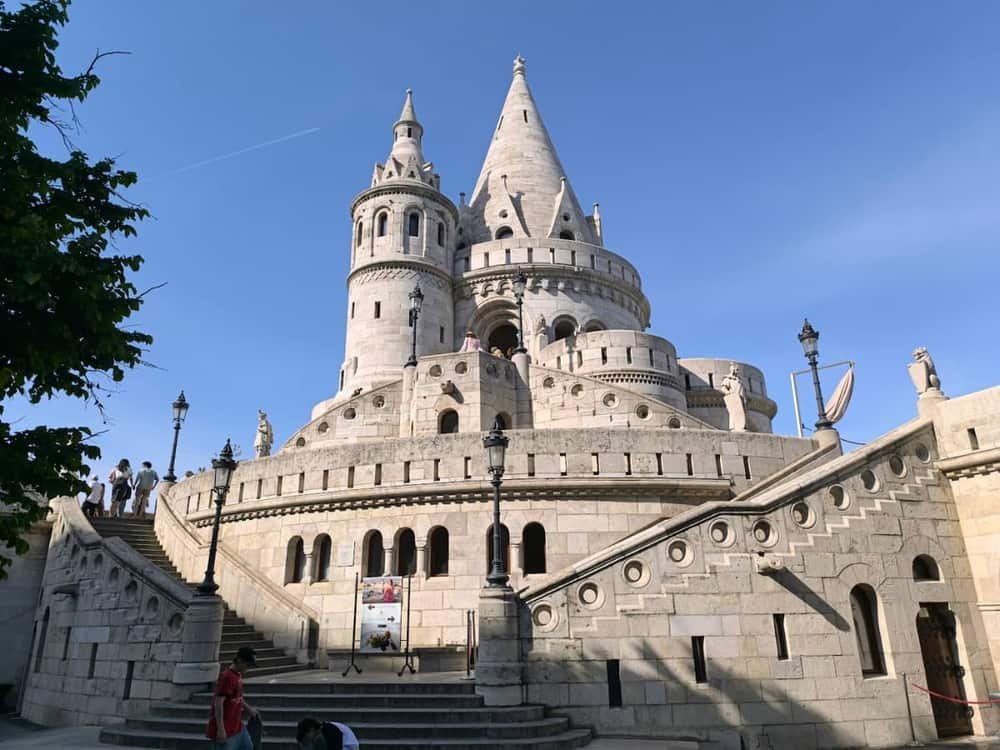
At the top, the essential stop is the Fisherman's Bastion — the white neo-Romanesque terrace with the seven turrets, one for each of the Magyar tribes. The upper towers charge admission; the lower terrace is free and the view from it is almost identical. Take the free one.
Walk south along the plateau to Buda Castle, which now holds the Hungarian National Gallery. Unless you specifically want Hungarian painting, do not go in on a one-day trip — you do not have the hours.
If twentieth-century history is your thing, Hospital in the Rock, in the tunnels under the hill, is the one museum on the hill worth an hour. Book ahead; entry is by timed tour.
Late morning: down and across
Come down the hill on the eastern side and cross the Chain Bridge on foot. It opened in 1849, was the first permanent bridge between Buda and Pest, and the walk across it is the single best five minutes of the day.
You arrive in Pest at Széchenyi István tér, with the Gresham Palace on your right — an Art Nouveau masterpiece, now a hotel, worth a look at the lobby if the doorman is relaxed.
Midday: the Parliament and the river
Walk north along the embankment to the Shoes on the Danube Bank: sixty pairs of iron shoes on the stone, marking the spot where Arrow Cross militiamen shot Jewish Budapesters into the river in 1944–45. It takes two minutes to see and is the most affecting thing in the city.
Continue to the Parliament. The building is the third-largest parliament in the world and, seen from the embankment, the defining image of Budapest. Interior tours must be booked in advance and sell out days ahead in season — if you have not booked, the exterior and Kossuth tér are still worth the walk.
Lunch
Two honest options.
Cut inland to the streets behind St Stephen's Basilica — the basilica itself is free to enter, holds the mummified right hand of Hungary's first king, and has a dome terrace with the best central view in Pest. Around it, Hungarikum Bisztró does the traditional Hungarian repertoire properly and is booked out most evenings, so lunch is your chance.
Or, if you want the grand version, Central Grand Café, open since 1887.
Avoid Váci utca. The food there is worse and dearer than three streets in any direction.
Afternoon: Andrássy and Heroes' Square
Take the M1 from Bajcsy-Zsilinszky út. This is the oldest metro line on the European continent, opened in 1896, and it still runs in its original shallow tunnel with wooden-framed stations — it is a sight in its own right and costs the price of a normal ticket.
Ride it under Andrássy Avenue to Hősök tere. Above ground you get Heroes' Square, the Millennium Monument, and Vajdahunyad Castle a few minutes into the City Park behind it — a nineteenth-century architectural mash-up built to show off every Hungarian building style at once.
If you would rather have the boulevard than the park, get off at Oktogon and walk. The Opera House and the House of Terror are both on Andrássy, and the House of Terror — the former secret-police headquarters, now a museum of both dictatorships — is the more important of the two if you only have time for one.
Late afternoon: the bath
You are standing next to Széchenyi, the enormous neo-Baroque bath complex in the City Park, and this is the correct end to a walking day.
Go in for two hours. The outdoor pools run at 27°C and 38°C and stay open into the evening; in winter the steam over the water in the cold is the image everybody remembers from Budapest. Bring a towel and flip-flops or pay to rent them.
If you would prefer something older and quieter, Rudas has an Ottoman octagonal pool from 1566 under a domed roof, and a rooftop pool looking straight up the Danube — but it is back on the Buda side and breaks the line of this route. The full bath comparison will settle it.
Evening
Walk or take the M1 back down Andrássy and finish in District VII. Dinner around Kazinczy utca, then one drink in Szimpla Kert — the original ruin bar, in a derelict apartment block, and genuinely worth seeing once even if the crowd is not your thing.
What this route deliberately leaves out
Margaret Island, Memento Park, the Great Market Hall, the Dohány Street Synagogue interior, and every museum except one. That is not an oversight — it is the difference between seeing a city and photographing a list.
If any single one of those matters more to you than something above, swap it in and drop the bath. Do not try to add it.
Where to stay nearby
Live prices and availability on a map centred on this exact spot — hotels, apartments and hostels, so you can judge the walk from here rather than guess from an address.
Bookings made through this map earn us a commission. Your price is unaffected.