
Guides
Széchenyi Baths tickets: what to buy, what to skip, and when to go
Tony Denesa – Travel Advisor9 min read
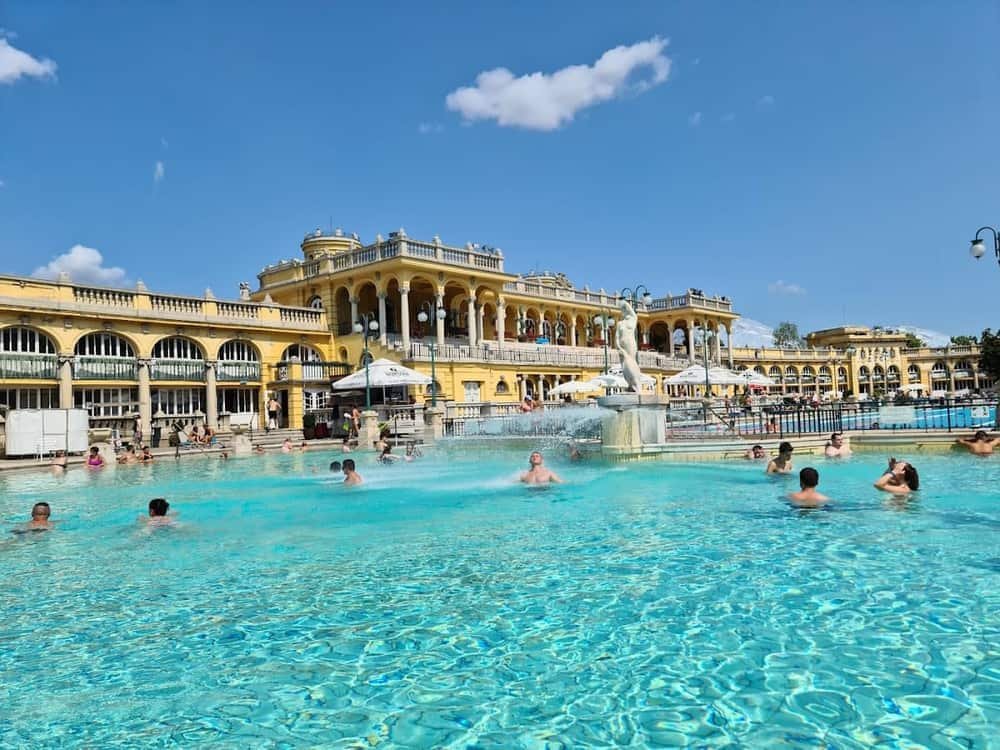
Széchenyi is the one everybody goes to, and mostly they go at the wrong time and buy the wrong ticket. Both are fixable in ten minutes.
What it is
A neo-Baroque complex of eighteen pools in the middle of City Park, opened in 1913 and fed by a thermal spring drilled to over a kilometre deep. It is the largest medicinal bath in Europe.
Three of the pools are outdoors, in the great yellow courtyard — one swimming pool at around 27°C and two thermal pools at around 38°C. Those three are the image of Budapest in winter: steam over the water, snow on the stonework, and men playing chess on floating boards.
The other fifteen are indoors, along with saunas, steam rooms and the medical departments, and most visitors never find them.
Ticket types, in plain terms
Day ticket with a locker is the default and the cheapest full-price option. You get a locker in a shared changing area.
Day ticket with a cabin costs a little more and gives you a private cubicle you keep for the day. It is worth the difference if you are two people sharing, or if you want somewhere to leave a bag you would rather not put in a locker.
Fast-track / skip-the-line tickets are sold by resellers, not by the bath. In high season the queue at the main entrance is real, and on a January weekday it does not exist. Judge accordingly.
Weekday and weekend prices differ, with weekends noticeably dearer.
A weekend day ticket runs around 12,000 Ft — official price list, checked August 2026. Bath prices across the city rose by roughly 5 per cent on 7 January 2026, so any figure you find published before that date is low.
Where to buy
At the door is fine outside peak hours and gives you the exact ticket you want.
Online, in advance is the answer at a weekend in summer or over the Christmas period. Buying through the bath's own site is cheapest; buying through a reseller adds a margin but bundles the queue-skip and, sometimes, a towel.
A city pass may include entry or a discount. Whether that pays depends entirely on how many other paid sights you will visit, and the maths is in that guide rather than here.
When to go, which matters more than the ticket
Best: a weekday morning, 06:00–09:00. The bath opens early, the outdoor pools are quiet, and the crowd is local and elderly. This is Széchenyi as it actually functions, and it is a completely different place from the same building at four in the afternoon.
Worst: Saturday afternoon in July. It is full, loud, and the outdoor pools are at capacity.
Best in the year: winter. The contrast between 38°C water and near-freezing air is the entire point, and December to February is when the place is at its best and cheapest.
Avoid Saturday nights unless you specifically want the Sparty — a night party with DJs in the outdoor pools, sold separately, aimed squarely at visitors and nothing like the bath on any other day. Worth doing if that is what you want; a shock if you turned up for a quiet soak.
What to bring
- Swimsuit. Compulsory in all mixed areas.
- Flip-flops. The floors are wet stone; you will regret bare feet.
- Towel. Rentable at the bath, and cheaper from a shop.
- Swimming cap is required in the lap pool, not in the thermal pools.
- A padlock is not needed — the lockers use a wristband.
- Cash is not needed either; cards work throughout.
Leave valuables at your accommodation. The lockers are secure enough for a phone and a wallet, not for a laptop.
The bit most people miss
The indoor thermal pools are quieter, hotter and architecturally the better half of the building. The route through them is confusing on purpose — it was designed as a medical facility — and most visitors do the outdoor courtyard and leave.
Walk the inner ring at least once.
If Széchenyi is not the one for you
It is the largest and the most photographed. It is not automatically the best for your trip:
- Gellért is the beautiful one — Art Nouveau, glass roof, mosaic — and quieter.
- Rudas has the Ottoman octagonal pool from 1566 and a rooftop pool over the Danube.
- Palatinus on Margaret Island is the summer lido where the city's own families go.
The bath comparison guide sets out which suits which mood, and the etiquette piece covers the rules nobody tells you.
Tickets below are booked through partners and this site earns a commission. Buying direct from the bath is usually cheaper, and that is said here rather than buried.
Getting there
M1 to Széchenyi fürdő puts you at the door — and the M1 itself is the oldest underground line on the European continent, so the journey is part of the visit. Trolleybus 70, 72 and 79 also stop nearby.
The bath is inside City Park, a few minutes from Heroes' Square, Vajdahunyad Castle and the zoo. That cluster is the reason a bath visit slots neatly into a City Park day rather than needing one of its own.
Two hours or four
Two hours is enough for the outdoor courtyard and one circuit indoors, and it is what most visitors want.
Four hours starts to make sense if you use the saunas, the steam rooms and the indoor thermal pools properly, and if you treat it as a place to sit rather than a sight to tick.
There is no hourly ticket — the day ticket is the unit — so the only cost of staying longer is your own time.
With children
Allowed, and Széchenyi handles families better than the smaller Ottoman baths do. The 27°C outdoor swimming pool is the one they will use.
Under-14s are not permitted in the sauna areas. In summer the open-air strand baths are the better family choice altogether — the family guide covers which.
Where to stay nearby
Live prices and availability on a map centred on this exact spot — hotels, apartments and hostels, so you can judge the walk from here rather than guess from an address.
Bookings made through this map earn us a commission. Your price is unaffected.