Guides
Budapest in summer: how to enjoy a city that hits 35°C
Tony Denesa – Travel Advisor10 min read
Budapest summers are hotter than most visitors expect. The city sits in the Carpathian Basin, which traps heat: July and August regularly reach 33–35°C, the air is humid, and the stone-and-asphalt centre holds the warmth well into the night.
This is not a reason to avoid the season. It is a reason to plan the day differently — outdoors early and late, indoors or in water in the middle. Almost every mistake a summer visitor makes comes from running a spring itinerary in August heat.
For the opposite season, see Budapest in winter.
Rebuild the day around the heat
The workable shape is simple:
- 07:00–11:00 — walking, sightseeing, the Castle Hill, anything uphill or unshaded
- 11:00–16:00 — water, museums, a long lunch, the caves
- 16:00–21:00 — parks, the river, the second half of the sightseeing
- 21:00 onwards — the city is at its best, and this is when locals appear
The middle five hours are the ones people waste by queuing outside the Parliament at two in the afternoon. Do that at nine.
Water, properly
The Hungarian answer to summer is the *strand* — an open-air bath complex with grass, trees and several pools. It is a completely different institution from the grand indoor thermal baths, and it is where the city actually goes.
Palatinus on Margaret Island is the flagship: eleven outdoor pools, slides, a wave pool, and lawns to lie on. Come early on a weekend or not at all.
Római Strandfürdő in Óbuda is the local favourite — older, cheaper, shaded by mature trees, and much less international.
Dagály is large and rarely full, and Csillaghegy in the north is the quietest of the four.
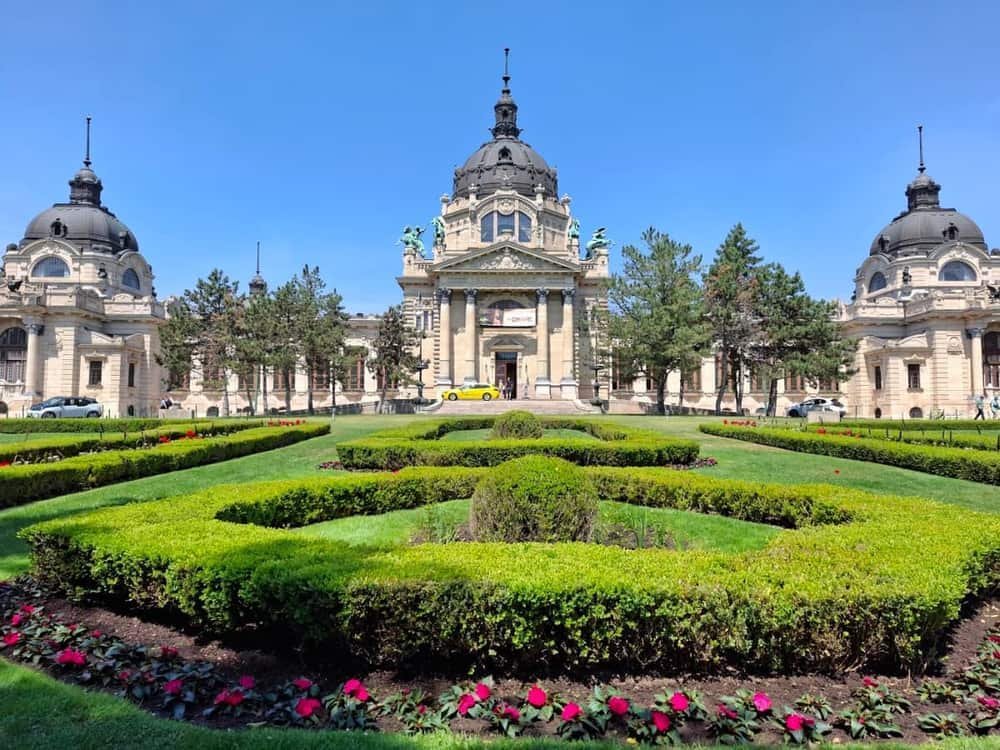
Of the grand baths, Széchenyi works in summer because most of it is outdoors: the 27°C swimming pool in the middle is the one to aim for in August, not the 38°C thermal pools. Gellért has an outdoor wave pool that dates from 1927 and still runs.
Skip the small Ottoman baths — Rudas and Király — until the weather turns. They are magnificent in February and airless in August. The full comparison sets out which is which.
Margaret Island, which exists for this
Margaret Island is 2.5 km of park in the middle of the Danube, closed to through traffic, and it is the city's summer release valve.
The musical fountain at the southern end runs to a timed programme through the day. There is a Japanese garden, a small zoo, the ruins of a thirteenth-century Dominican convent, a running track around the perimeter and bicycles and pedal-carts for hire. The water tower at the centre is a UNESCO-listed 1911 structure with a viewing gallery.
It is the single best place in Budapest between four and eight on a hot afternoon.
The hills, which are genuinely cooler
The temperature difference between the centre and Normafa in the Hegyvidék hills is real — usually four or five degrees, and the beech woods do the rest.
Take the cogwheel railway up, walk the ridge, and come down on the Libegő chairlift from Jánoshegy. The strudel stalls at Normafa have been feeding walkers for generations and are still the correct lunch.
The Children's Railway — staffed by ten to fourteen-year-olds — runs across the ridge and is the best thing in the city for anyone travelling with children. See the family guide.
Underground, where it is 12°C
Budapest is built over a genuine cave system, and in a heatwave that is not a curiosity but a strategy.
Pálvölgyi and Szemlő-hegyi caves hold a constant twelve degrees. Hospital in the Rock under Castle Hill is a wartime hospital and nuclear bunker, cool and gripping. Gellért Hill Cave is a working church inside the rock.
Bring a layer — twelve degrees after 35 is a shock.
Evenings, which are the point
Budapest in summer is a night city, and the ruin bars are only part of it.
The garden bars — *kertek* — open only for the season: Ellátó Kert, Szimpla Kert and the courtyards around Kazinczy utca in the Jewish Quarter. Rooftops such as 360 Bar and High Note SkyBar come into their own between eight and ten.
There is open-air cinema in courtyards across the city, concerts in the park, and the Parliament lit from the water — best seen from tram 2 or from the Citadella promenade on Gellért Hill.
20 August, St Stephen's Day, is the national holiday, with a fireworks display over the Danube that draws hundreds of thousands of people. If you are in town, go; if you are arriving that day, expect closures.
What to expect on price and crowds
July and August are peak season and priced accordingly. They are also, counter-intuitively, the emptiest weeks for Budapest's own residents — a large part of the city leaves for Lake Balaton in August, which means restaurants that are hard to book in May sometimes have tables.
The budget guide is more useful in summer than in any other season.
Practical
- Drink more than you think. Public drinking fountains are common in parks and the tap water is excellent.
- Air conditioning is not universal. Check that your accommodation has it, particularly in older apartment buildings — a top-floor flat under a roof in August is unbearable without it.
- The baths require flip-flops, and swimming caps for the lap pools.
- Storms arrive fast. Summer afternoons frequently break with a short, violent thunderstorm. It clears in an hour.
Where to stay nearby
Live prices and availability on a map centred on this exact spot — hotels, apartments and hostels, so you can judge the walk from here rather than guess from an address.
Bookings made through this map earn us a commission. Your price is unaffected.