Blog
Budapest's Art Nouveau: the man who tried to invent a Hungarian architecture
Tony Denesa – Travel Advisor8 min read
Budapest was largely built in a rush. Between the 1867 Compromise that gave Hungary self-government and the First World War, the city roughly tripled in size, and almost everything a visitor photographs went up in that window.
Most of it is historicist — neo-Gothic Parliament, neo-Renaissance Opera, neo-Romanesque Fisherman's Bastion. Competent, confident, and borrowed.
Then there is Ödön Lechner, who thought that was exactly the problem.
The argument Lechner was making
Lechner's position was political as much as aesthetic. Hungary had just won a measure of independence inside the Habsburg empire, and its public buildings still spoke Vienna's architectural language. He wanted a Hungarian one.
There was an obvious difficulty: Hungary had no monumental medieval tradition to revive, because the Ottoman occupation had destroyed most of it. So Lechner went looking elsewhere — to Hungarian folk embroidery and pottery, to Persian and Indian ornament, on the then-current theory that the Magyars had come from the east and that eastern decoration was therefore ancestrally theirs.
What he built out of that is unlike anything else. The forms are broadly Art Nouveau. The surfaces are Hungarian folk art rendered in Zsolnay ceramic — the Pécs factory whose glazed, frost-proof tiles made it possible to put embroidery patterns on a roof and have them survive a Central European winter.
Where to see it
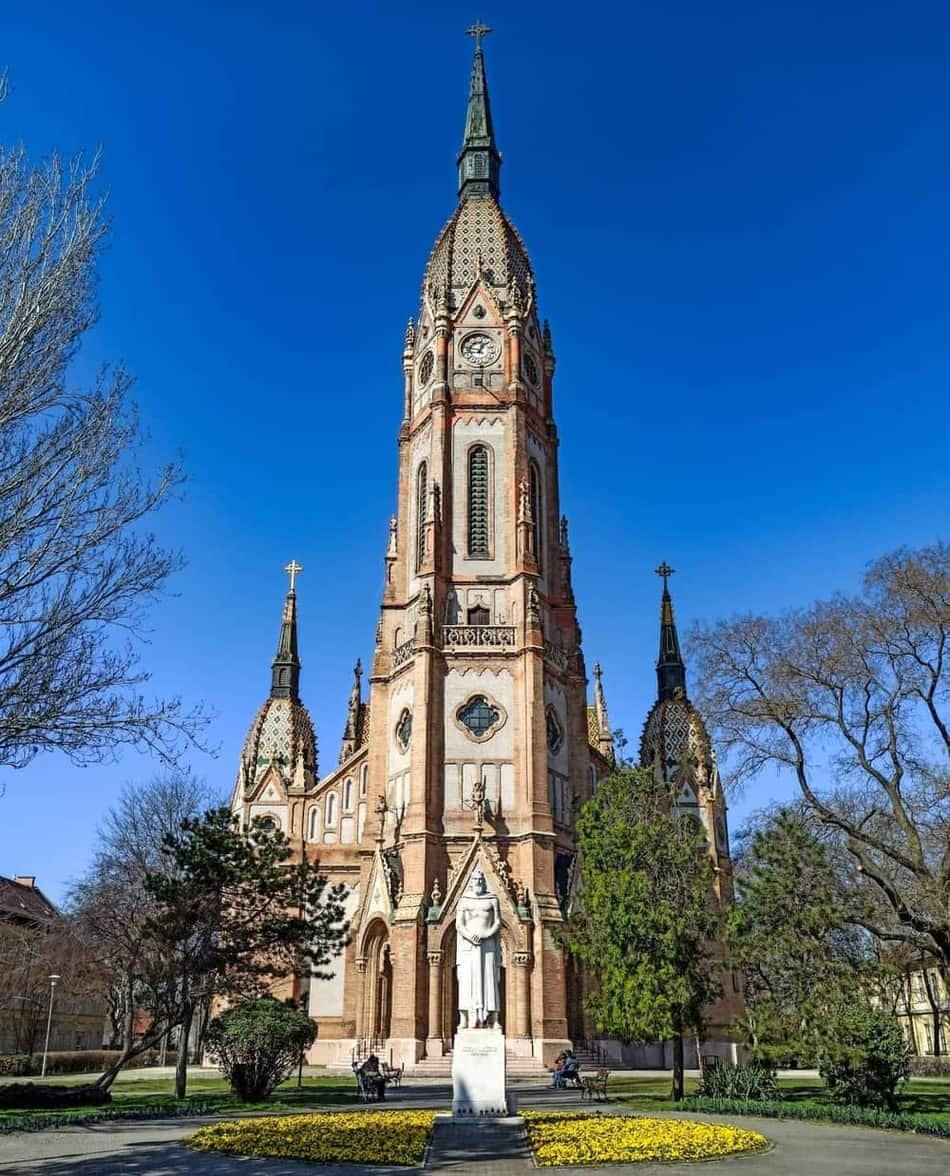
Szent László Church, out in Kőbánya, 1897.
This is the one almost nobody visits and the one most worth the journey. Lechner had a free hand on a suburban site, and the result is the clearest statement of the whole idea: a tower and roof in patterned green and gold ceramic, folk motifs running across surfaces that on any other church would be plain stone, and an interior that reads as a Hungarian textile turned into a building.
It is twenty minutes out on the M3 and it is free.
The Museum of Applied Arts, 1896, is the famous one — a green-and-gold ceramic roof and a white interior that borrows from Mughal India. It has been under long-running restoration; check before making the trip.
The Postal Savings Bank, 1901, near Liberty Square in District V, is Lechner at his most exuberant: bees climbing ceramic hives up the facade towards the roof, because it was a savings bank and bees save. The building is not generally open, but the exterior is the point and it is a two-minute walk from the Parliament.
The Institute of Geology, 1899, has a roof of blue Zsolnay tiles with figures carrying a globe on the ridge. Out in Terézváros's eastern reaches, and worth the detour if this article has convinced you of anything.
The rest of the movement
Lechner was not alone, and the wider Hungarian *szecesszió* is scattered across the centre.
Gellért Baths, 1918, is the one you can get inside for the price of a bath ticket — a glass-roofed hall, Zsolnay tiling everywhere, mosaic and stained glass. It is the most enjoyable Art Nouveau interior in Hungary precisely because you experience it in a swimsuit rather than on a guided tour.
The Gresham Palace, 1906, at the Pest end of the Chain Bridge, is now a hotel; the lobby and the wrought-iron peacock gates are usually visible to anyone who walks in politely.
Bedő House on Honvéd utca, 1903, holds a small museum of Hungarian Art Nouveau across three floors, and is the best single place to understand the movement's furniture and objects.
The Elephant House at Budapest Zoo, 1912, is a listed building in its own right — a domed, tiled, vaguely Orientalist pavilion that happens to contain elephants.
A walk that connects them
A workable half-day: start at the Postal Savings Bank near Liberty Square, walk to the Gresham Palace at the bridge, cross to Gellért and go in for two hours.
Then, on a separate morning and only if you are convinced, take the M3 out to Kőbánya for Szent László. That one is the argument in its purest form, and standing in front of it is the moment Lechner's project stops being an art-historical footnote.
Why it stopped
Lechner's style did not become the national architecture he intended. It was expensive, it depended on one ceramics factory, and after 1918 Hungary lost two-thirds of its territory and had other concerns. Later modernism had no use for ornament at all.
So what survives is a handful of buildings by one man and his circle, in one city, in a language nobody else spoke — which is a good part of why Budapest looks like nowhere else.
Where to stay nearby
Live prices and availability on a map centred on this exact spot — hotels, apartments and hostels, so you can judge the walk from here rather than guess from an address.
Bookings made through this map earn us a commission. Your price is unaffected.