Blog
The bridges of Budapest, and why every one of them is a rebuild
Tony Denesa – Travel Advisor7 min read
Buda and Pest were separate towns until 1873, and for most of their history the only way between them was a boat, or in a hard winter the ice. The bridges are what made Budapest a single city, which is why what happened to them in 1945 matters so much.
In January and February 1945, the retreating German army blew up every single bridge across the Danube in Budapest. Not damaged — destroyed, all of them, along with much of the city. Every bridge you can walk across today is either a reconstruction or a post-war replacement.
That fact reframes the walk. These are not merely nineteenth-century monuments; they are a statement about a city putting itself back together.
Széchenyi Chain Bridge
The oldest, the most famous, and the one to walk.
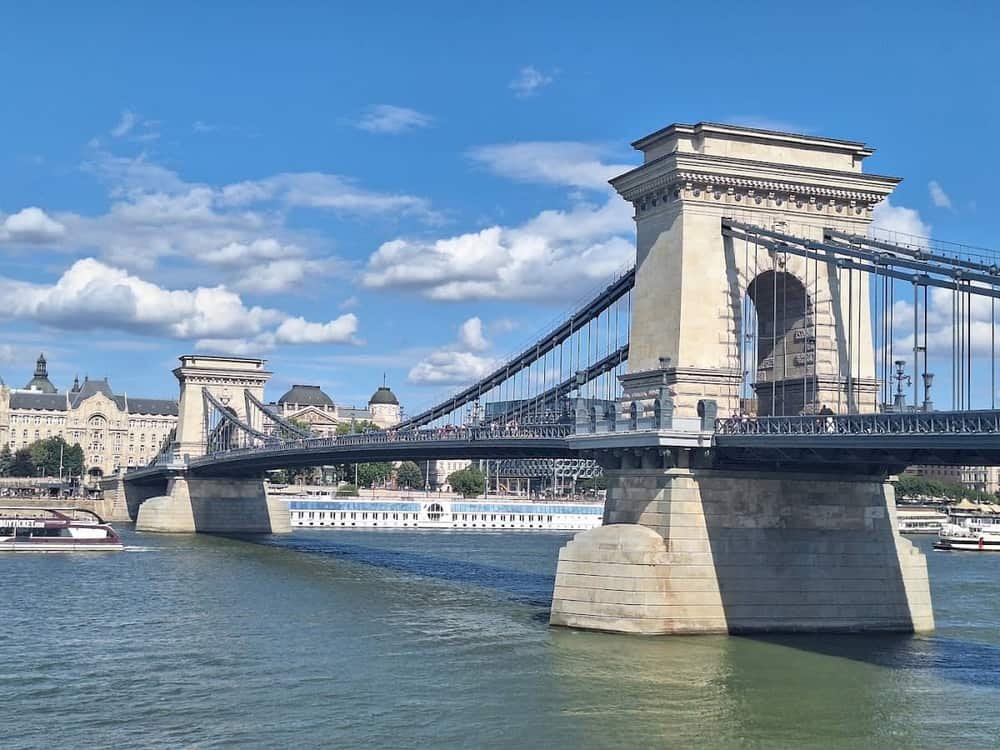
The Chain Bridge opened in 1849 as the first permanent crossing between Buda and Pest. It was pushed through by Count István Széchenyi — the reformer after whom half of Hungary is named — designed by the English engineer William Tierney Clark and built by the Scottish engineer Adam Clark, who were unrelated despite the surname.
It changed the country. Before it, the nobility were exempt from tolls; on the Chain Bridge everyone paid, and that small commercial fact is generally read as the first crack in Hungarian feudal privilege.
Blown up in 1945, rebuilt and reopened in 1949, exactly a hundred years after the original. The stone lions at each end are original.
Walk it. Five minutes, best at night, and the finest single stretch of any Budapest itinerary. It leads directly from District V to the foot of Castle Hill and the funicular.
Liberty Bridge — Szabadság híd
The green one, and the local favourite.
Opened in 1896 for the millennium celebrations, originally named after Franz Joseph, who drove in the final silver rivet himself. It is the shortest of the central bridges and the most ornamented — Art Nouveau ironwork, and *turul* birds, the mythological falcon of Hungarian origin legend, on top of each mast.
It connects the Great Market Hall on the Pest side to the Gellért Baths and Gellért Hill on the Buda side, which makes it the most useful bridge on this list for a visitor.
In recent summers it has periodically been closed to traffic and taken over by people sitting on the ironwork — an informal tradition that started during roadworks and refused to die.
Elizabeth Bridge — Erzsébet híd
The white one, and the only one not rebuilt to its original design.
Named after Empress Elisabeth — Sisi — who was genuinely popular in Hungary in a way her husband was not. The original, opened in 1903, was the longest single-span suspension bridge in the world at the time. It was destroyed in 1945 like the rest, and the damage was too severe to reconstruct: what stands now is a clean modernist cable bridge from 1964.
It lands at the foot of Gellért Hill, next to the Gellért Hill Cave church, and is the fastest way from the centre to the Citadella promenade.
Margaret Bridge — Margit híd
The one with a branch in the middle.
Opened in 1876 on an unusual plan: it crosses the Danube at an angle, in two straight sections meeting over the tip of Margaret Island, with a short spur running down onto the island itself. The angle exists because the two halves each meet their own bank square on.
It carries tram 4 and 6, which run around the Grand Boulevard and are among the busiest tram lines in the world.
There is a darker chapter: in November 1944 the bridge exploded during rush hour while under preparation for demolition, killing hundreds of civilians and workers — before the systematic destruction of the rest in 1945.
The rest
Petőfi Bridge — a plain 1937 girder bridge, rebuilt 1952, carrying the outer boulevard past Ferencváros and the Ludwig Museum.
Rákóczi Bridge — 1995, the newest central crossing, and the one to know if you want the classic photograph: it is the standard vantage point for a sunset shot back up the river with every other bridge in line.
Árpád Bridge — the longest, crossing the north end of Margaret Island towards Óbuda and Aquincum.
Megyeri Bridge — the modern cable-stayed motorway crossing at the far north, by Újpest. Not for walking, but visible from the water.
How to see them properly
Three ways, in ascending order of effort.
Tram 2 along the Pest embankment passes under or beside most of them for the price of a single ticket, and does it at water level.
The Citadella promenade on Gellért Hill puts every central bridge in one frame. This is the view on the postcards, and it is free.
Walk the Chain Bridge at eleven at night, when the lights are on and it is nearly empty. Then walk up to the Fisherman's Bastion, which is also free and also open, and look back at what you just crossed.
Where to stay nearby
Live prices and availability on a map centred on this exact spot — hotels, apartments and hostels, so you can judge the walk from here rather than guess from an address.
Bookings made through this map earn us a commission. Your price is unaffected.