Guides
Driving to Budapest: vignettes, borders and where to leave the car
Tony Denesa – Travel Advisor12 min read
Budapest is an easy city to drive to and a difficult one to drive in. The first part is motorway all the way from most directions; the second part is a dense nineteenth-century street grid where the centre is a paid parking zone and a great deal of it is one-way.
The short version: get the vignette before you touch a motorway, park the car once, and use the public transport for the rest of the trip.
The vignette — *e-matrica*
Hungary charges for motorway use through an electronic vignette. There is no sticker. You buy a right of use that is tied to your registration plate, and gantry cameras check it.
Buy it before you enter the motorway. Not after. There is no grace period worth relying on, and the penalty for travelling without one is many times the price of the vignette itself.
Where to buy:
- online at the national toll operator's site, or through its app
- at petrol stations near the border and along the network
- at motorway service areas
What to buy, for an ordinary car:
- D1 is the category for a passenger car with up to seven seats.
- 10-day, monthly and annual national vignettes cover the whole motorway network.
- County (megye) vignettes are cheaper and cover one county only. They are excellent value if your route crosses two or three counties and you know which — and a false economy if you are not certain, because the county boundaries are not intuitive.
For a weekend trip to Budapest from a neighbouring country, the 10-day national is almost always the right answer: it removes the question entirely.
Check the plate you type. The vignette is matched to the characters you enter, so a typo means you have bought a valid vignette for a car that is not yours. Keep the confirmation — by email or in the app — until you are home.
Driving rules that differ
- Alcohol: zero. Hungary has a genuine 0.00 limit for drivers. Not 0.02, not "one beer". Zero.
- Dipped headlights are compulsory outside built-up areas, day and night, all year.
- Speed limits: 50 in built-up areas, 90 on ordinary roads, 110 on expressways, 130 on motorways. Enforcement is camera-heavy and fines arrive.
- Winter tyres are not legally mandatory, but the roads in the Buda hills are steep and are not always cleared quickly.
- Emergency number is 112.
- A hi-vis vest, warning triangle and first-aid kit are required equipment.
Parking in Budapest
This is where visitors lose money, and the rules are worth ten minutes.
The centre is a paid zone. Charging generally runs Monday to Friday, 08:00–20:00, and in the inner districts — District V above all — it extends into Saturday. Sundays and public holidays are normally free, but the exceptions are exactly in the districts you want to be in, so check the sign on the street rather than assuming.
Tariffs are zoned, and District V is the most expensive in the country. District VI, VII and IX are cheaper; the outer districts are cheaper again or free.
How to pay: at the machine, or — much easier — through a mobile parking app, which is what everyone here uses. Machines take coins and cards.
The much better option: park and ride. The P+R car parks at the metro termini are cheap or free with a valid transport ticket, and they are the correct answer for a two- or three-day visit. Leave the car at the end of a metro line, buy a travelcard, and do not think about the car again until you leave.
The useful ones are at the ends of the M2, M3 and M4 lines. From any of them the centre is fifteen to twenty-five minutes.
Hotel parking is worth asking about and worth paying for if you are staying in District V — but note that a great many central hotels have no parking at all, because the buildings are from the 1880s.
What the car is actually good for
Once you are in Budapest, the car is a liability. The centre is walkable, the transport network is cheap and dense, and parking is the most expensive part of a city break here.
Where the car earns its place is the day out: the Danube Bend at Szentendre, Visegrád and Esztergom; Lake Balaton; Gödöllő; or the wine country at Eger. Those are awkward by train and straightforward by car.
A two-day plan with a car
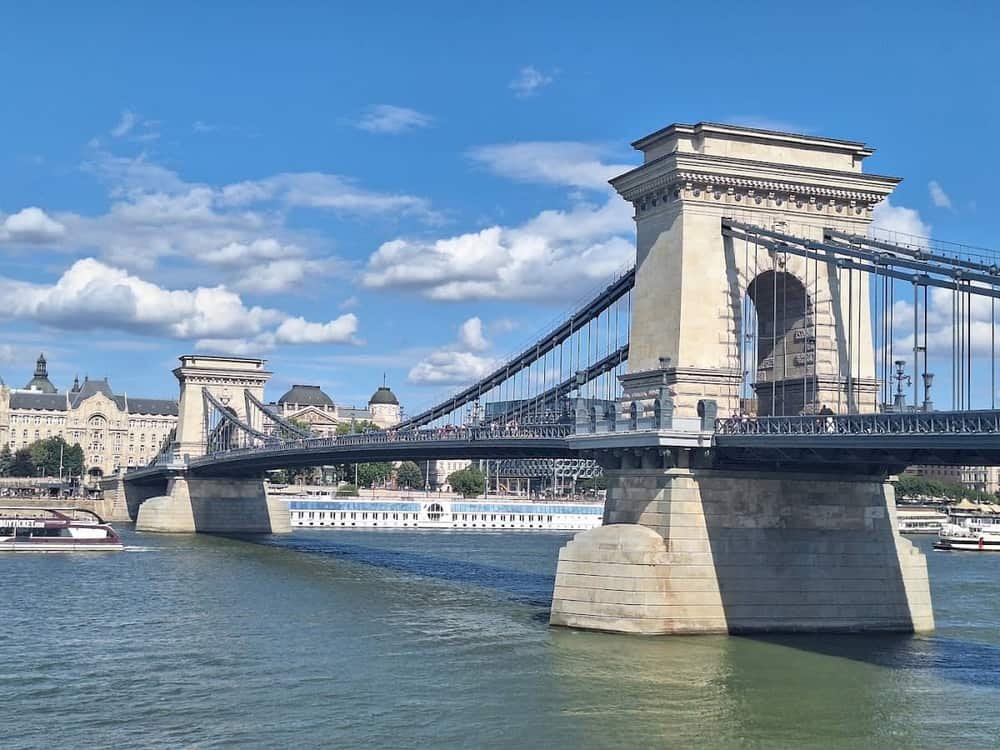
Day one. Arrive, park at a P+R or at the hotel, and do not move the car again. Castle Hill in the morning, Chain Bridge on foot, Parliament and the embankment, then Széchenyi Baths in the late afternoon. Evening in District VII.
Day two. Andrássy Avenue and Heroes' Square by the M1, the Great Market Hall for lunch, and either the Museum of Fine Arts or a second bath. Drive out in the evening, or stay a third night.
With a third day, take the car: the Danube Bend loop north — Szentendre, Visegrád, Esztergom — is about 120 km round trip and is the best day out from the city.
The one-day and three-day itineraries cover the walking versions in more detail.
The last thing
Budapest is not a low-emission-zone city and there is no congestion charge, so nothing stops you driving into the middle of it. That is the trap — it is entirely possible to drive into District V, circle for thirty minutes, and pay a great deal to leave the car somewhere inconvenient.
Park once, on the edge, and take the metro.
Where to stay nearby
Live prices and availability on a map centred on this exact spot — hotels, apartments and hostels, so you can judge the walk from here rather than guess from an address.
Bookings made through this map earn us a commission. Your price is unaffected.