The city
1956: the twelve days Budapest fought the Soviet Union
Tony Denesa – Travel Advisor9 min read
On 23 October 1956 a student demonstration in Budapest turned into an armed uprising against the Hungarian communist government and the Soviet troops stationed in the country. It lasted less than two weeks. It failed militarily and it changed the political history of the Eastern bloc.
What led to it
Hungary after 1949 was a Stalinist state under Mátyás Rákosi, who described himself as Stalin's best Hungarian pupil and governed accordingly: show trials, a secret police — the ÁVH — that ran a network of informers and torture cells, forced collectivisation, and a standard of living that fell while the propaganda insisted otherwise.
Stalin died in 1953. Khrushchev's 1956 "secret speech" denouncing him reached Hungary and made the Rákosi position untenable. Reformists inside the party looked to Imre Nagy, a communist who had briefly been prime minister and had been pushed out for advocating a slower, gentler course.
Meanwhile Poland had just extracted concessions from Moscow without invasion. Hungarian students watched and drew a conclusion.
The twelve days
23 October. A student march sets out to the statue of the Polish general Józef Bem in Buda, then crosses to Parliament, growing to a crowd in the hundreds of thousands. A delegation goes to the radio building on Bródy Sándor utca to broadcast their demands; the ÁVH open fire. That night the enormous Stalin statue in the City Park is pulled down, leaving only the boots on the plinth.
24–28 October. Soviet tanks enter the city. Fighting is heaviest in District VIII, around Corvin köz and the Práter utca cinema, where lightly-armed groups — many of them teenagers — fight tanks in narrow streets using petrol bombs. Imre Nagy is made prime minister.
28–30 October. A ceasefire. Soviet forces withdraw from the city. For a few days Hungary is, functionally, free: political parties re-form, the press publishes without censorship, workers' councils take over factories — most determinedly in Csepel.
1 November. Nagy announces that Hungary is leaving the Warsaw Pact and declares neutrality, and appeals to the United Nations.
4 November. The Soviet army returns in force. Fighting continues for days in the industrial districts. Nagy takes refuge in the Yugoslav embassy; he is later lured out under a guarantee of safe conduct, arrested, tried in secret and executed in 1958.
Around 2,500 Hungarians and 700 Soviet soldiers were killed. Roughly 200,000 people left the country in the weeks that followed, across the Austrian border — one of the largest refugee movements in post-war Europe.
Why it mattered anyway
The revolution failed, and the government installed afterwards under János Kádár lasted until 1989. But 1956 destroyed something important: the claim that communist states governed with the consent of their workers. The people fighting in Corvin köz were factory workers and students, not aristocrats, and the workers' councils that formed were more radical than the party they opposed.
For a great many Western communists, 1956 was the year they left the party.
Where to see it
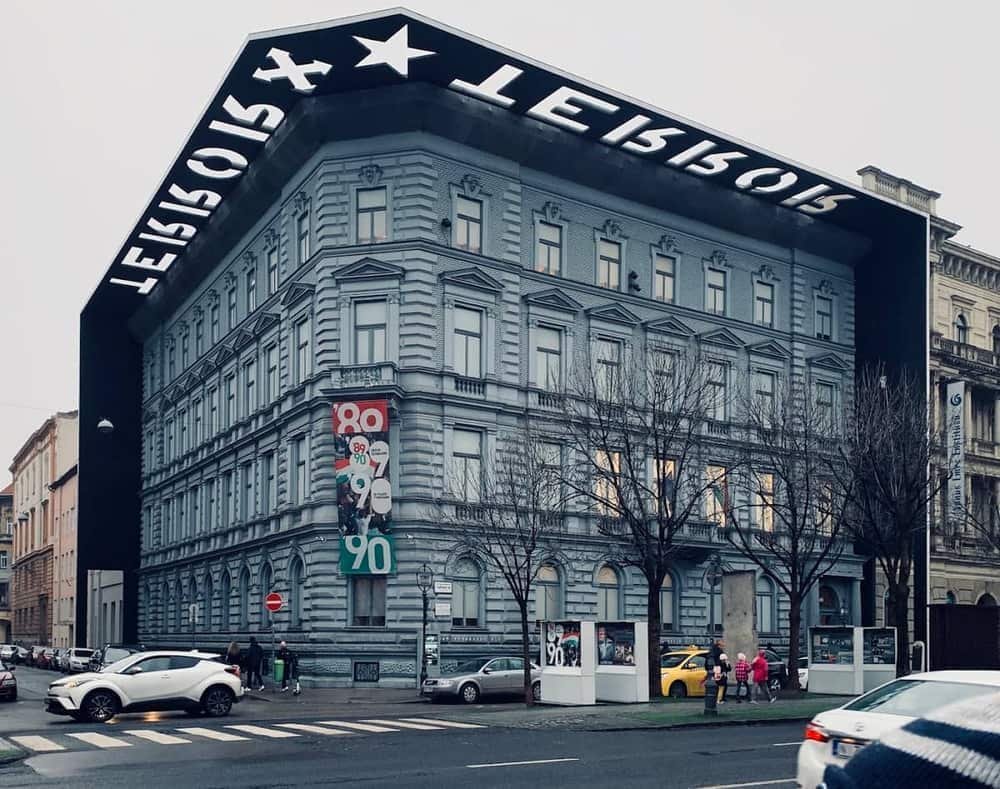
The House of Terror, Andrássy út 60, is the building the Arrow Cross used as headquarters and then the communist secret police used after them — the same address, the same cellars, two regimes. It is now a museum of both. It is the most-visited site of this history and is deliberately, heavily staged; go, but read something else afterwards.
Corvin köz, in District VIII, is where the heaviest street fighting happened. There is a memorial and the cinema is still there.
Kossuth tér, in front of the Parliament, holds a memorial to those shot in the square on 25 October. An underground exhibition beneath it covers the day.
Plot 301 at the New Public Cemetery in Kőbánya is where Imre Nagy and those executed with him were buried in unmarked graves, several face-down, at the far edge of the ground. They were exhumed and reburied with honours in June 1989 before a quarter of a million people — a ceremony generally read as the moment Hungarian communism lost the argument. It is a long walk inside a very large cemetery and it is a burial ground, not a sight.
Memento Park, out in the south-west, holds the statues removed from the city after 1989 — including a reconstruction of Stalin's boots.
The bullet holes. Once you know, you see them: facades across District VIII and District IX still carry them, many deliberately left unrepaired.
Reading the date
23 October is a national holiday. Expect ceremonies at Kossuth tér and at the Corvin köz memorial, some transport disruption, and a political atmosphere — the meaning of 1956 is still actively contested in Hungarian politics, and the commemorations are not neutral events.
If you want the plain history rather than the argument about it, the Holocaust Memorial Center and the National Museum both handle the twentieth century with less staging than the House of Terror does.
Where to stay nearby
Live prices and availability on a map centred on this exact spot — hotels, apartments and hostels, so you can judge the walk from here rather than guess from an address.
Bookings made through this map earn us a commission. Your price is unaffected.