The city
The Ottoman century and a half, and what it left behind
Tony Denesa – Travel Advisor8 min read
In 1526 the Hungarian army was destroyed at Mohács and the king was killed. In 1541 the Ottomans took Buda without a fight, by invitation and then by occupation. They held it until 1686.
That is 145 years — longer than the United States has existed as a continental power — and it is the least visible period in Budapest's history.
What Ottoman Buda was like
It was a provincial capital, the seat of a *pasha*, and a garrison town on the empire's north-western frontier. The population changed: much of the Hungarian nobility left, Ottoman administrators and soldiers arrived, and a substantial Balkan and Sephardic Jewish population settled.
Churches became mosques. New mosques were built, and *hammams*, and dervish lodges. The Ottoman traveller Evliya Çelebi, who visited in the seventeenth century, described a city of minarets and bathhouses.
Pest, across the river, was smaller and less important — a walled town rather than a capital.
Why so little survives
The 1686 siege. A Holy League army retook Buda after a bombardment and assault lasting months, and the town was left in ruins. What the fighting did not destroy, the reconstruction did: mosques were demolished or converted back, minarets came down, and the Habsburg rebuilding that followed was deliberate about erasing the previous regime's architecture.
The result is that in a city occupied for a century and a half, the Ottoman inheritance is a handful of buildings — and one enormous exception.
The baths, which are the exception
The Ottomans did not invent bathing in Buda; the Romans were here first, and the springs never stopped. But the Ottomans built the *type* of bath that the city still uses: a domed octagonal pool, dim light falling through coloured glass set into the dome, side pools at different temperatures.
Rudas, built around 1566 by Pasha Sokollu Mustafa, has the finest surviving Ottoman pool in the city — an octagon under a dome on eight pillars, with the light coming down in shafts. It is still in daily use, which is the remarkable part: this is not a monument, it is a bath, and you go in with a towel.
Király was begun in 1565 and built *inside* the city walls deliberately, so that the garrison would have bathing water in a siege. It is small, dark and almost unchanged.
Veli Bej, from 1575, was restored relatively recently and is the least known of the three. It is also the calmest.
The bath comparison guide sets out which suits whom.
The tomb on the hill
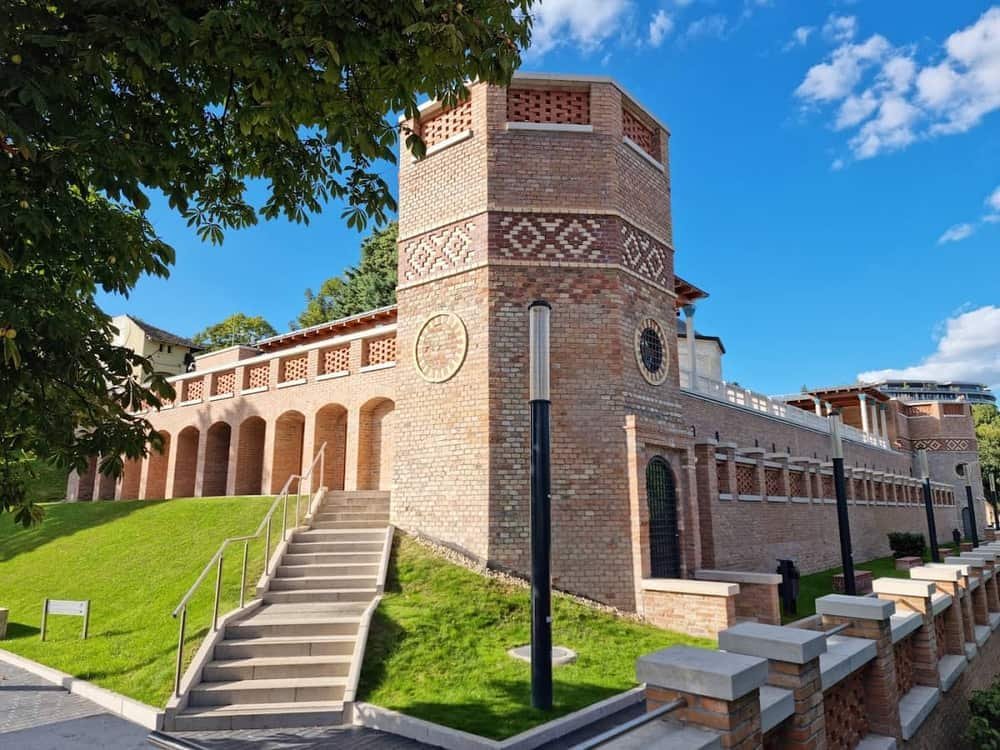
Gül Baba's tomb on Rózsadomb, in the Buda Hills district, is the northernmost Islamic pilgrimage site in Europe.
Gül Baba was a Bektashi dervish who died in Buda in 1541 — by tradition during the celebrations for its capture — and the octagonal tomb built over him has stood since the 1540s. It survived the reconquest because it was converted into a Christian chapel rather than demolished, and it has been restored several times since, most recently as a joint Hungarian-Turkish project.
The name means "father of roses", and the terraced rose garden around it is the reason most people go.
The rest of it
The Tomb of Gül Baba aside, look for:
- fragments of Ottoman stonework built into later buildings around Castle Hill
- the Türbe of the last pasha, Abdurrahman Abdi Arnavut, who died defending Buda in 1686 — his memorial stone on the castle hill was placed by later Hungarians and describes him, unusually for a defeated enemy, as a heroic opponent
- the street layout of the Víziváros — Watertown — below the castle, which is partly Ottoman
How the period is remembered
Uncomfortably, and with less venom than you might expect.
Hungarian national memory treats the Ottoman period as a catastrophe — the country was split three ways, the population fell, and the century and a half is generally described as a lost one. But the specific antagonism has faded, and modern Hungarian-Turkish relations lean heavily on shared origin myths about the steppe.
Meanwhile the most-photographed thing in Budapest after the Parliament is arguably a bath, and the oldest bath in daily use is Ottoman.
What the period actually did to the country
The demographic and political consequences outlast the buildings, and they are the reason the century and a half still matters.
Hungary was split three ways after 1541: Ottoman Hungary in the centre, Royal Hungary in the north and west under the Habsburgs, and the Principality of Transylvania in the east, semi-independent and playing the two empires against each other. The kingdom that had been one of the larger states in medieval Europe ceased to function as a unit.
The population fell heavily in the war zone between the two empires, and the depopulated land was later resettled — with Germans, Serbs, Slovaks and Romanians — which reshaped the ethnic map of the Carpathian Basin permanently and set up much of the region's later politics.
And the Habsburgs, who arrived as liberators in 1686, stayed. Hungary spent the following two centuries inside their empire, which is the story that produces the 1867 Compromise and the boom that built the city you are standing in.
Where to feel it rather than read it
Go to Rudas on a weekday morning, pay for the thermal section, and sit in the octagonal pool under the dome with the light coming down through the coloured glass.
It was built for men of a garrison in the 1560s, it has been in continuous use since, and nothing else in Budapest connects you to the period in the same way — because it is not a museum of the Ottoman century, it is a functioning piece of it.
Where to stay nearby
Live prices and availability on a map centred on this exact spot — hotels, apartments and hostels, so you can judge the walk from here rather than guess from an address.
Bookings made through this map earn us a commission. Your price is unaffected.