The city
Aquincum: the Roman city under Budapest
Tony Denesa – Travel Advisor8 min read
Budapest's history is usually told from 1873, when three towns merged, or from 1849 and the Chain Bridge. Both are far too recent. There was a city of thirty thousand people on this stretch of the Danube in the second century AD, and a good deal of it is still in the ground in Óbuda.
The frontier
Rome reached the Danube under Augustus and made the river the northern edge of the province of Pannonia. That was not an arbitrary line: the Danube was defensible, navigable, and beyond it were peoples Rome had no intention of governing.
A frontier that long — the *limes* — needed garrisons, and a garrison of that size needed a town. Aquincum grew from a military camp into the capital of Pannonia Inferior, with a legionary fortress, a civilian town beside it, and a population that reached roughly 30,000 to 40,000 at its height.
The name is probably Celtic in origin, from a word for water, and the water is the point: the same thermal springs that later gave Budapest its bath culture were being used here in the second century.
What was in it
The civilian town had the full apparatus of a Roman provincial capital. A forum. A basilica. Public baths — several. A market hall. Underfloor heating in the better houses. Two amphitheatres, one military and one civilian, of which the military one seated somewhere around 13,000 people: larger than anything else in the city until the twentieth century.
There was a mithraeum, a temple to Mithras, which tells you the garrison had eastern soldiers in it. There was an aqueduct running south from the springs.
And there was the hydraulis — a water-powered pipe organ, found in fragments in 1931 and dated to AD 228. It is the most complete surviving Roman organ anywhere, and it is in the museum.
The people, briefly
A Roman frontier town was a mixing point rather than a colony of Italians. The inscriptions found at Aquincum name soldiers from Syria, Gaul, North Africa and the Balkans alongside local Celtic Eravisci who had been there before Rome and stayed after it arrived.
The best-known individual is Sabina, wife of the organ-maker, known only because her husband's memorial to her survived — one of the very small number of ordinary people from this city whose name we have at all.
What happened to it
Pressure on the frontier built through the third and fourth centuries. Aquincum was fortified, then reduced, then abandoned as Roman control of Pannonia collapsed in the early fifth century. The stone was quarried for centuries afterwards by everybody who came next.
Then the site was farmland, and then it was a suburb, and the ruins sat under Óbuda until systematic excavation began in the nineteenth century.
Seeing it
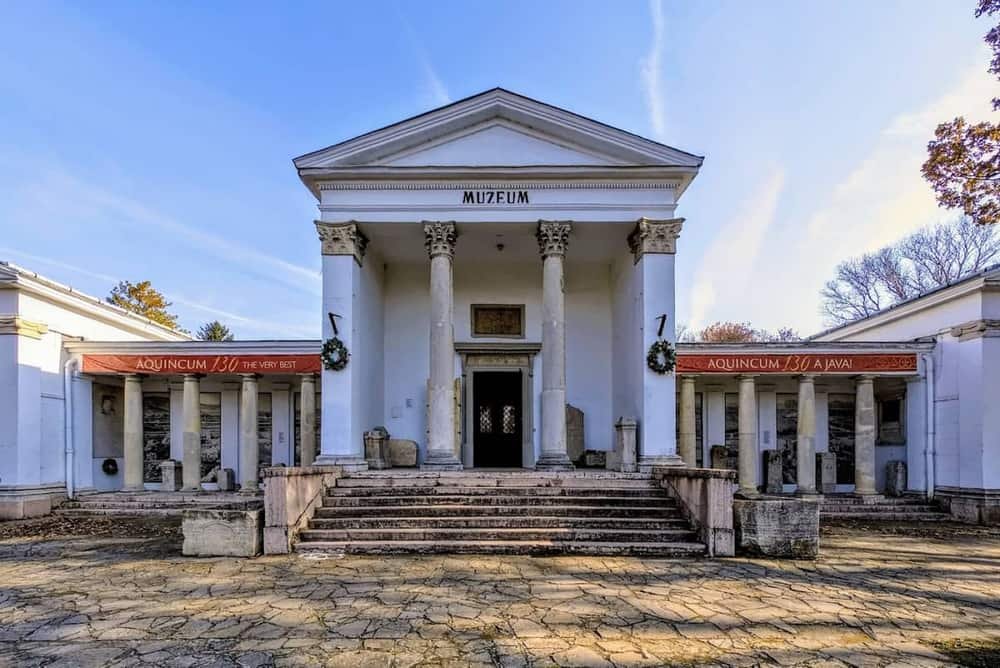
The Aquincum Museum sits on the excavated civilian town. You walk the actual street grid — the foundations, the drains, the bath complex, the market — with a modern museum building holding the finds, including the water organ and a good collection of everyday objects.
It is genuinely a ruin field rather than a reconstruction, which means it rewards a slow walk and a dry day. Allow two hours.
The military amphitheatre is separate, further south in Óbuda, sitting in the open between apartment blocks with traffic going round it. It is free, unfenced, and one of the stranger sights in the city: a Roman arena used as a shortcut.
The Hercules Villa, also in Óbuda, holds mosaics.
Fragments turn up elsewhere. There is Roman stonework visible in the underpass at Flórián tér, and the museum's own collection extends well beyond what is on the main site.
Why it is worth the trip out
Óbuda is twenty minutes north of the centre on the HÉV suburban railway or the M3 and a bus, and almost no visitor goes. That is the appeal: Aquincum is never crowded, and standing on a Roman street with a suburban railway going past is a particular kind of experience that the more polished sites in the centre cannot give you.
Combine it with the Baroque main square of Óbuda and, in summer, the Római Strandfürdő — an open-air bath a short walk away, named after the Romans, and fed by the same springs they used.
What Rome left in the ground
The physical inheritance is larger than the museum. Roman roads set the alignment of several streets in Óbuda; the modern route north along the Buda bank follows the line of the *limes* road that ran the length of the frontier.
More importantly, Rome established the pattern the city has followed ever since: settle where the hot water is. The Romans built baths at Aquincum because springs surfaced there, the Ottomans built Rudas and Király on the same geological line fifteen centuries later, and the nineteenth century built Széchenyi and Gellért on it after that.
Three separate civilisations, no continuity of population or language between them, and all three put their bathhouses in the same places — because the geology gave them no choice.
A caution about what you will see
Aquincum is not Pompeii and it does not pretend to be. The walls stand roughly knee to waist height across most of the site; the mosaics are fragmentary; the reconstructed street is a reconstruction.
What it gives you instead is scale and plan — you can see how a Roman provincial town was organised, which street the market was on, where the water went. If that is what you want from an archaeological site it is excellent. If you are expecting standing buildings, the Hungarian National Museum has the better finds in a conventional gallery.
Where to stay nearby
Live prices and availability on a map centred on this exact spot — hotels, apartments and hostels, so you can judge the walk from here rather than guess from an address.
Bookings made through this map earn us a commission. Your price is unaffected.