The city
Jewish Budapest: the quarter, the ghetto, and what survived
Tony Denesa – Travel Advisor10 min read
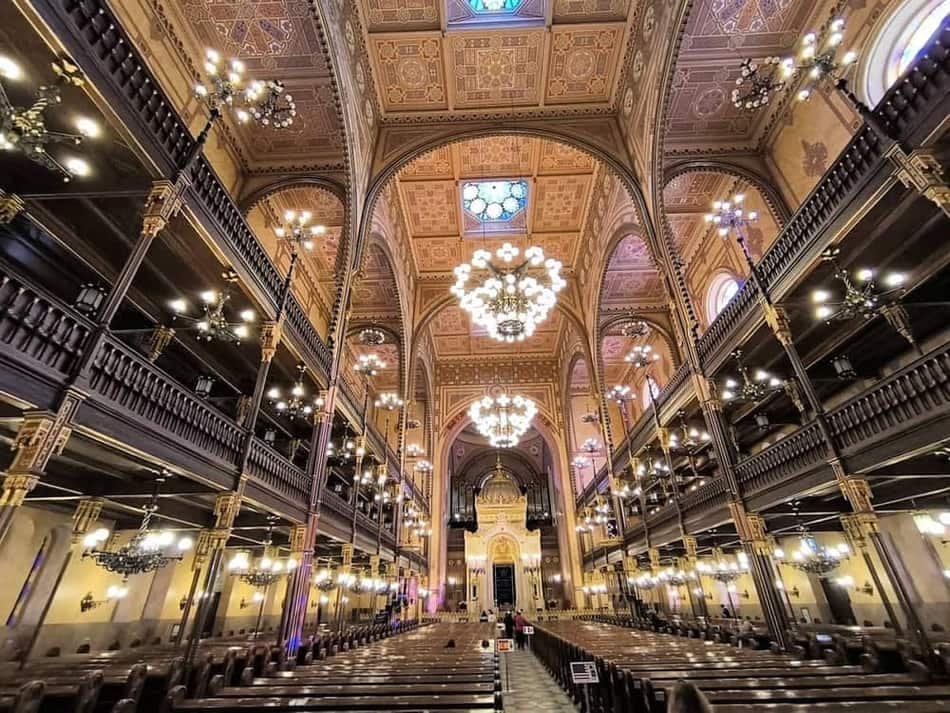
The area most visitors know as the ruin bar district is District VII, Erzsébetváros, and it is the historic Jewish quarter of Budapest. Both facts are true at once, and the second one is the older.
How the community got here
Jews lived in Buda from the medieval period, with a community on the castle hill that was expelled, readmitted and expelled again as rulers changed. The modern community is largely a nineteenth-century story.
Under the Habsburgs, restrictions eased through the 1800s, and emancipation came in 1867 with the Compromise that created Austria-Hungary. What followed was rapid: Jewish families moved into Pest in large numbers, and into the professions, commerce, medicine, law, journalism and the arts.
By the early twentieth century Budapest's Jewish population was around 200,000 people — roughly a quarter of the city, and the largest Jewish community in Europe outside the Soviet Union. It was also, unusually, a strongly assimilated one: Hungarian-speaking, patriotic, and central to the culture of the city rather than adjacent to it.
The nickname *Judapest*, coined as an insult by Vienna's mayor Karl Lueger, was a measure of how visible that presence was.
What they built
The Dohány Street Synagogue, completed in 1859, is the largest synagogue in Europe and the second largest in the world. It seats around 3,000. The style is deliberately Moorish Revival — onion domes, two towers, brick and ceramic — and it was designed by a Viennese architect, Ludwig Förster, for a congregation that wanted a building as public and confident as a cathedral.
Behind and around it sit the Heroes' Temple, the Jewish Museum, and a cemetery that is not original to the site — it exists because of what happened in 1944.
Two further synagogues survive nearby: the Rumbach Street Synagogue, an Otto Wagner building, restored and reopened in recent years, and the Kazinczy Street Synagogue, Orthodox and Art Nouveau, still in daily use.
1944
Hungary allied with Nazi Germany, passed anti-Jewish laws from 1938, and conscripted Jewish men into forced labour service, where tens of thousands died. But until March 1944 the Jewish population of Hungary — unlike almost everywhere else in occupied Europe — had not been deported en masse.
That changed when Germany occupied Hungary in March 1944. Deportations began in the countryside in May and moved with extraordinary speed: within roughly eight weeks, over 400,000 Hungarian Jews were deported, the majority to Auschwitz, most of them murdered on arrival.
Budapest's turn came later, and the city's Jews were, for a period, protected by the sheer administrative difficulty of moving a population that size. Diplomats — Raoul Wallenberg of Sweden, Carl Lutz of Switzerland, Giorgio Perlasca posing as a Spanish diplomat, and others — issued protective papers and established safe houses, and saved tens of thousands.
In October 1944 the Arrow Cross, Hungary's own fascist party, took power. What followed was not deportation but murder in the city itself: two ghettos, mass shootings on the Danube bank, and a winter in which people were taken to the river, made to remove their shoes, and shot into the water.
Shoes on the Danube Bank — sixty pairs of iron shoes on the embankment — marks that. It takes two minutes to see and is the most affecting thing in Budapest.
Around 100,000 of the city's Jews survived, a far higher proportion than in the Hungarian countryside, and that is why a community still exists here at all.
What is here now
The Dohány Street complex — synagogue, museum, memorial garden and the cemetery in the courtyard, where those who died in the ghetto in the winter of 1944–45 are buried. The Emanuel Tree, a metal weeping willow with victims' names on its leaves, stands in the memorial garden.
The Holocaust Memorial Center in Ferencváros is the serious museum on this history — a restored synagogue with a permanent exhibition that traces the process from law to deportation. It is less visited than Dohány Street and is the better place to actually understand what happened.
Stolpersteine — small brass cobblestones set into pavements outside the last freely-chosen homes of victims — are scattered across the city. You will walk over them without noticing unless you know to look.
The ghetto wall survives in fragments in a courtyard off Király utca.
And the ruin bars
The quarter's buildings survived the war largely intact but emptied of the people who had lived in them, and then decayed through forty years of state ownership and deferred maintenance.
In the early 2000s that dereliction became the raw material for the ruin bars: Szimpla Kert opened in an abandoned apartment block, others followed, and District VII became the city's nightlife centre.
The relationship between the two facts is uncomfortable and worth stating plainly. The bars are in these buildings because the buildings were empty; the buildings were empty because of what happened to the people in them. Neither fact cancels the other. Both are why the district looks the way it does — and it is entirely possible to spend a good evening at Mazel Tov and an honest hour at Dohány Street on the same day.
Seeing it well
Go to the Holocaust Memorial Center first if you want the history, and to Dohány Street for the building and the memorial garden. Walk between the three surviving synagogues — they are within ten minutes of each other and represent three different answers to the same question about how to be Jewish in a nineteenth-century European city.
Then look down, occasionally, for the brass stones.
Note that the Dohány Street complex is closed on Saturdays and Jewish holidays, and that a head covering is provided at the door.
The community now
Budapest has the largest Jewish community in Central Europe today — estimates run from 35,000 to around 100,000 depending on how the question is asked, which is itself a legacy of a century in which answering it truthfully was dangerous.
It is a functioning community rather than a heritage site. The Kazinczy Street synagogue holds daily services. There are Jewish schools, a rabbinical seminary that ran continuously even under communism — the only one in the Eastern bloc — kosher butchers and bakeries around Kazinczy utca, and an annual Jewish Cultural Festival.
Rosenstein in District VIII is the best known of the Jewish-Hungarian restaurants, cooking the crossover cuisine that came out of this community: goose, matzo-ball soup, cholent, and Hungarian paprika technique applied to a kosher repertoire.
That crossover is worth noticing while you eat it. Much of what is now served as classic Hungarian home cooking passed through Jewish kitchens in this city, and the food guide covers where the tradition survives.
Where to stay nearby
Live prices and availability on a map centred on this exact spot — hotels, apartments and hostels, so you can judge the walk from here rather than guess from an address.
Bookings made through this map earn us a commission. Your price is unaffected.