The city
The statues Budapest argues about
Tony Denesa – Travel Advisor8 min read
Every city argues with its monuments. Budapest does it unusually openly, and a visitor who knows what to look at can read a century of Hungarian politics off the statuary in an afternoon.
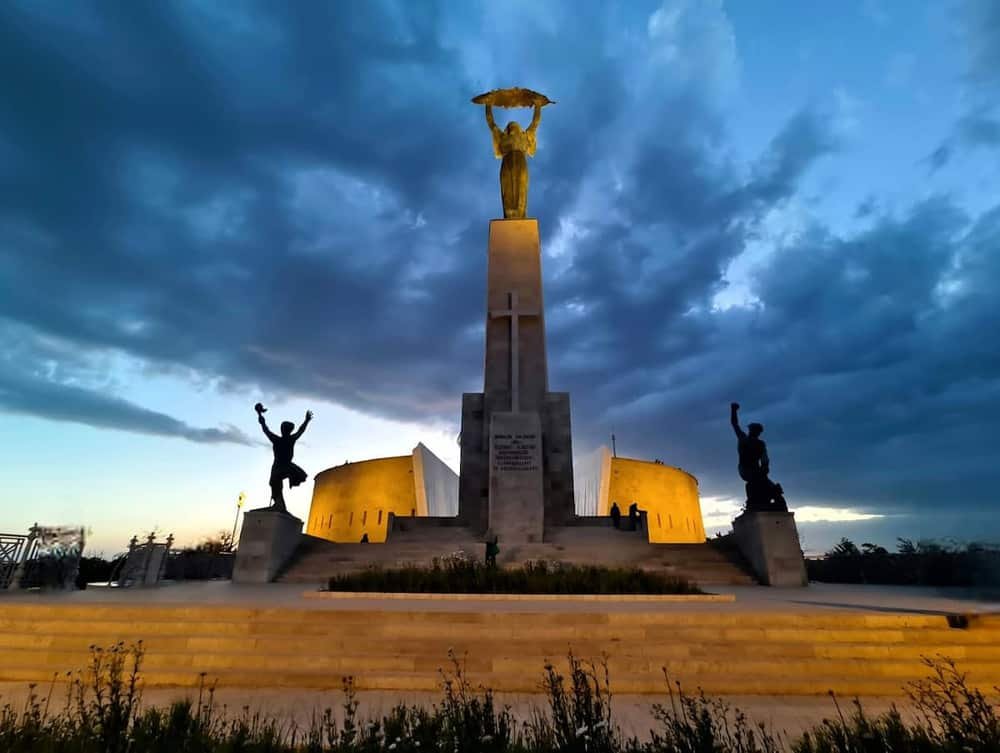
The Liberty Statue, which changed its mind
The bronze woman holding a palm frond on top of Gellért Hill is visible from most of the city. She went up in 1947 as a Soviet liberation monument, with an inscription thanking the Red Army and a Soviet soldier standing at the base.
After 1989 the city had a decision to make. It kept the statue and rewrote it: the soldier was removed to Memento Park, the inscription was replaced, and she now commemorates *all those who sacrificed their lives for the independence, freedom and prosperity of Hungary* — a formulation carefully broad enough to cover everyone and commit to no one.
The statue is the same. The meaning was reassigned. It is the single clearest example in the city of how monuments get repurposed rather than removed.
Memento Park, which is the good answer
After 1989 Budapest had a field's worth of Lenins, Marxes, Hungarian communist leaders and Red Army memorials, and three obvious options: leave them up, smash them, or hide them.
It chose a fourth. Memento Park, opened 1993 in the south-west, collects them in an open-air museum with a deliberately anti-triumphal layout — the paths lead nowhere, in a design meant to comment on the ideology rather than celebrate its defeat.
It also holds a reconstruction of Stalin's boots: the eight-metre statue in the City Park was pulled down during the 1956 revolution and cut up, leaving only the boots on the plinth, which became the defining image of that October.
It is out of the way and it is the most intellectually serious museum in Budapest.
The one that stayed
Not everything moved. The Soviet War Memorial on Szabadság tér — Liberty Square, in District V — is still standing, in one of the most prestigious squares in the city, a few minutes from the Parliament.
It stays because of a bilateral treaty obligation to maintain Soviet war graves and memorials. It is periodically vandalised and periodically defended, and it sits within sight of a statue of Ronald Reagan and, since 2011, one of Harry Hill Bandholtz, an American general who in 1919 is said to have stopped Romanian troops looting the National Museum using nothing but a riding crop.
That one square holds a Soviet obelisk, an American president and an American general, all installed for different political reasons at different times. It is worth ten minutes.
The memorial with the counter-memorial
The most active argument in the city is also on Szabadság tér.
In 2014 the government erected a Memorial to the Victims of the German Occupation: the Archangel Gabriel, representing Hungary, attacked by an imperial eagle representing Germany.
Historians and the Jewish community objected immediately, on the grounds that the monument presents Hungary purely as a victim of 1944 and erases Hungarian participation in the deportation of over 400,000 people — which was carried out largely by Hungarian gendarmerie and administration. It was erected overnight, without the promised public consultation.
In front of it, protesters built a living memorial: suitcases, photographs, personal documents, stones and handwritten notes about individual victims, laid on the pavement facing the official monument. It has been maintained and replenished continuously ever since.
Both are there. The pavement answers the plinth, and the arrangement is one of the more remarkable things in Budapest — a state monument and an unofficial rebuttal, permanently facing each other.
The Jewish Budapest page covers the history the argument is about.
The ones without controversy
Shoes on the Danube Bank, 2005 — sixty pairs of iron shoes on the embankment. No inscription arguing anything, no figure, no triumph. It is the most affecting memorial in the city and the least rhetorical.
The Imre Nagy statue stood for years on a small bridge near Szabadság tér, looking towards the Parliament; it was moved in 2018, which was itself a political act and was reported as one.
Little Princess on the tram railing by the Chain Bridge, and the statue of the anonymous chronicler in City Park, are the two most photographed and the two least loaded.
How to read them
The useful question in front of any Budapest monument is not what it shows but who put it there and when. The dates 1947, 1956, 1989, 2014 and 2018 all mark statuary decisions, and the city has never settled into a single official version of its own twentieth century.
That is not a flaw in the city. It is the most interesting thing about walking around it.
Where to stay nearby
Live prices and availability on a map centred on this exact spot — hotels, apartments and hostels, so you can judge the walk from here rather than guess from an address.
Bookings made through this map earn us a commission. Your price is unaffected.