The city
1867 and 1896: the deal and the deadline that built Budapest
Tony Denesa – Travel Advisor9 min read
Two dates explain the look of Budapest more than any other, and neither is a battle.
1867: the Compromise
Hungary had risen against Habsburg rule in 1848, been defeated in 1849 with Russian help, and spent the following decade and a half under direct rule from Vienna.
Then Austria lost a war. The defeat by Prussia at Königgrätz in 1866 left the empire needing a settlement with its largest unhappy nation, and in 1867 it got one: the Ausgleich, the Compromise.
The terms were unusual. The empire became Austria-Hungary, a dual monarchy: one monarch, one army, one foreign policy, and otherwise two states with separate parliaments, separate governments and separate budgets. Franz Joseph was crowned King of Hungary in a ceremony in Buda, and Hungary got control of its internal affairs for the first time since the sixteenth century.
What that did to the city
It turned a provincial town into a capital, and the effect was immediate and enormous.
Buda, Pest and Óbuda were formally unified into Budapest in 1873. A Public Works Council was created with the power to plan on a city scale, and it did: Andrássy Avenue driven through the existing fabric from 1872, the Grand Boulevard laid out as an outer ring, the embankments engineered, and street after street of six-storey apartment blocks put up around courtyards.
The population roughly tripled between 1870 and 1900. By 1900 Budapest was the sixth-largest city in Europe and the fastest-growing.
1896: the deadline
The Magyar tribes were reckoned to have entered the Carpathian Basin in 895–896. The thousandth anniversary gave the new capital something a building boom rarely has — a fixed date to finish by.
The millennium programme is most of the tourist map:
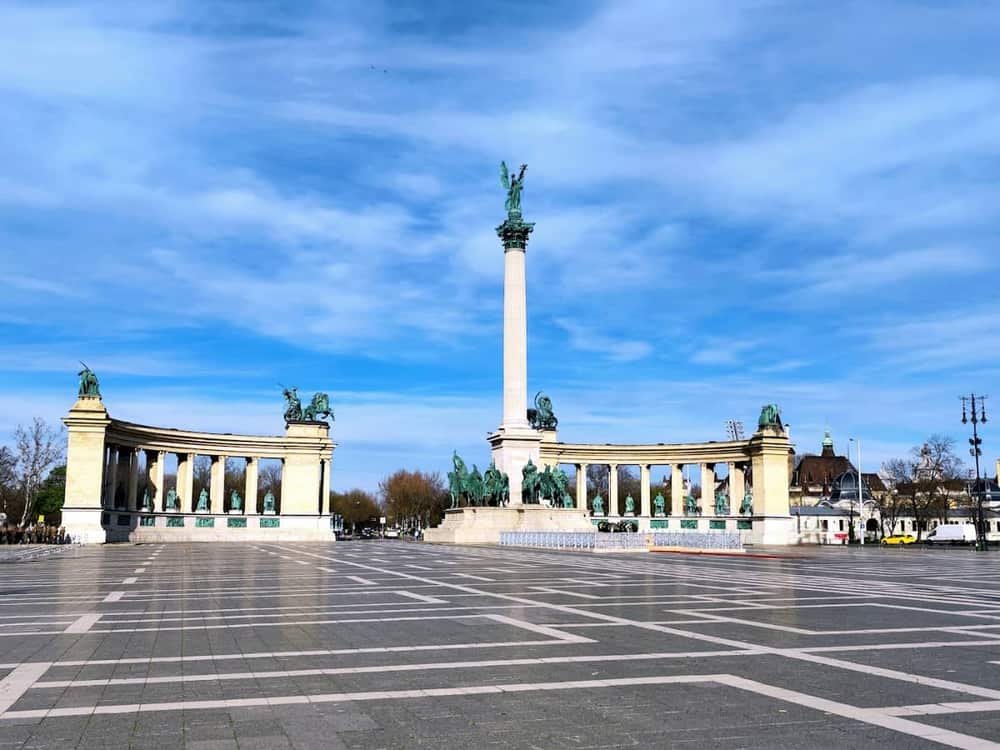
- Heroes' Square and the Millennium Monument, with its colonnade of Hungarian rulers and the Archangel Gabriel on the column.
- The M1 metro, built under Andrássy in about twenty months because nobody would allow tram tracks on the new boulevard — and now the oldest underground line on the European continent.
- Vajdahunyad Castle in the City Park, built as a temporary exhibition pavilion assembling copies of buildings from every Hungarian architectural period. It was so popular that it was rebuilt permanently in stone.
- The Museum of Fine Arts, begun for the anniversary.
- The Parliament, whose foundation stone was laid in 1885 with 1896 as the target. It missed — the building was finished in 1904 — but its dome was inaugurated on time.
- Fisherman's Bastion followed shortly after, in the same national-romantic spirit.
The exhibition itself ran through 1896 in the City Park and drew several million visitors.
What the boom was actually about
It is worth naming the politics, because it is written into the buildings.
The dual monarchy gave Hungary autonomy but not independence, and the architecture argues about that continuously. The Parliament is neo-Gothic because Westminster was — a deliberate reference to the older parliamentary tradition rather than to Vienna. Heroes' Square lines up a thousand years of Hungarian rulers, making a claim about continuity and legitimacy. Even Ödön Lechner's attempt to invent a Hungarian architectural language belongs to the same argument, from the other direction.
The millennium was a national statement dressed as an anniversary, and it was aimed at least partly at Vienna.
How it ended
Badly, and quickly.
Austria-Hungary went into the First World War in 1914 and did not come out. The Treaty of Trianon in 1920 reduced Hungary to about a third of its former territory and left roughly a third of ethnic Hungarians outside the new borders. That settlement remains the single most emotionally charged fact in Hungarian public life a century later, and a visitor will see references to it — maps, dates, monuments — without necessarily recognising them.
Budapest kept the buildings and lost the empire they had been built for, which is part of why the city feels slightly too grand for the country around it.
Seeing the period
Walk Andrássy Avenue end to end, from the centre to Heroes' Square — about forty minutes, and it is the boom in a single line. Ride the M1 back underneath it. Then City Park for Vajdahunyad and the Museum of Fine Arts, and finish at Széchenyi Baths, which is 1913 and the last building of the same confident era.
The architecture guide sets the styles out properly.
Where to stay nearby
Live prices and availability on a map centred on this exact spot — hotels, apartments and hostels, so you can judge the walk from here rather than guess from an address.
Bookings made through this map earn us a commission. Your price is unaffected.