Guides
Budapest museums: which ones, in what order, and which to skip
Tony Denesa – Travel Advisor10 min read
Budapest has a large number of museums, an unusually good one, and several that are recommended far more often than they deserve. On a short trip the question is not which are good — it is which one you should give three hours to.
Start here: the one to see
The House of Terror, Andrássy út 60.
It occupies the actual building used as headquarters by both the Hungarian fascist Arrow Cross and then the communist secret police, and it covers both dictatorships in the same rooms. The House of Terror is the museum that explains why Budapest looks and behaves the way it does, and if you see only one, this is it.
It is also heavily staged — the presentation is emotional and politically pointed, and it gives far more space to the communist period than the fascist one. Go, and read around it afterwards. The 1956 article and the communism article are the context.
The serious collections
Museum of Fine Arts, on Heroes' Square. Budapest's best international collection, with Egyptian and classical rooms and a genuinely important Spanish holding — El Greco and Goya among them. Restored and reopened after a long closure, and the strongest art museum in the city.
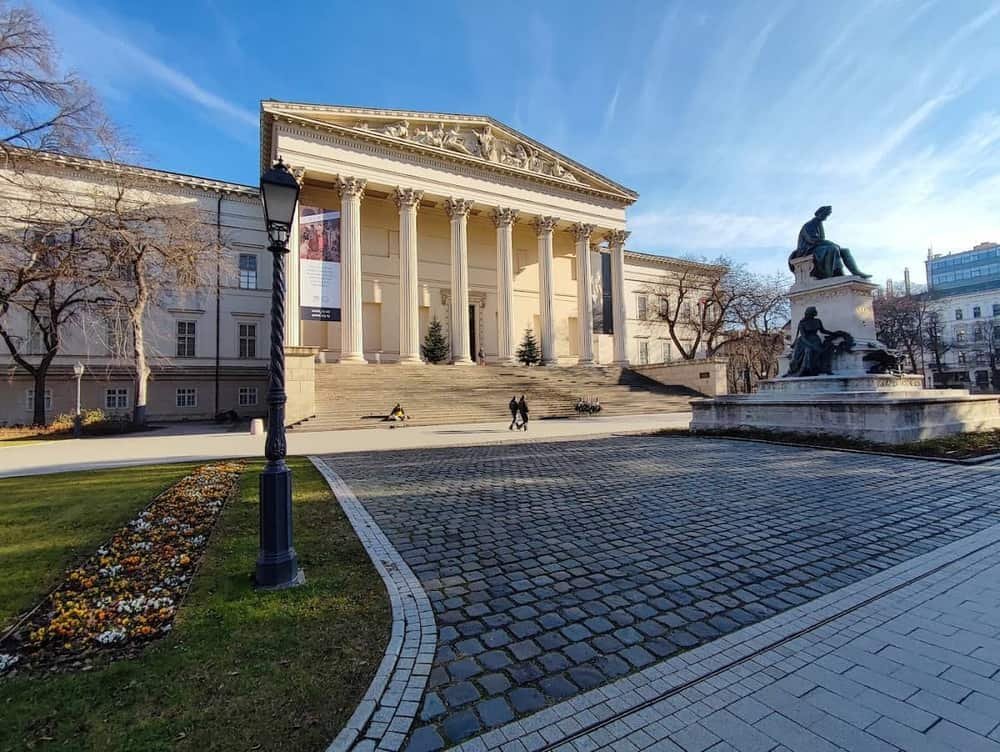
Hungarian National Museum, in the Palace Quarter. Founded in 1802, in an 1847 neoclassical building whose steps are where the 1848 revolution began. It tells the whole Hungarian story in one building, which makes it the right first museum for anyone who wants the history rather than the art.
Hungarian National Gallery, in Buda Castle. Hungarian painting and sculpture, strongest on the nineteenth century. Good rather than essential on a short trip — and note that the long-promised New National Gallery in City Park is not open, with a current target of 2028. Articles that describe visiting it are describing a building that does not yet exist.
Museum of Applied Arts. Lechner's green-tiled masterpiece near Ferencváros is one of the great art nouveau buildings in Europe, and it has been closed for renovation for years. Look at the exterior — that is the point of it anyway.
The ones that are experiences
Hospital in the Rock, under Castle Hill. A wartime emergency hospital and later nuclear bunker inside the hill's natural cave system, seen on a timed guided tour. Book ahead. It is the best ninety minutes on the Buda side and the caves article explains the geology under it.
Memento Park. The communist monuments removed from the city's squares in 1989, collected in a field on the southern edge. It takes half a day with the journey, and it is the most memorable thing on this page after the House of Terror. See Memento Park for how to get there.
Aquincum. The Roman town in Óbuda — streets, baths, an amphitheatre, and a reconstructed water organ. Aquincum is why Budapest is older than it looks.
Holocaust Memorial Center, Páva utca. A restored synagogue and a serious permanent exhibition, and much quieter than the Dohány Street Synagogue complex. The Jewish Budapest article covers both.
The new ones in City Park
The Liget development has produced two genuinely good buildings in City Park.
House of Music Hungary — Sou Fujimoto's perforated canopy, opened 2022, with a permanent exhibition on Hungarian and European music that is one of the best-designed museum experiences in the country. See the music article.
Museum of Ethnography — the new building with the sloping roof you can walk up. Worth it for the roof and the temporary exhibitions.
What to skip on a short trip
Anything described as an "experience", a "3D museum" or a "house of illusions" around Belváros. They are priced like real museums and are not.
And, honestly, most second museums. The two-day itinerary allows one for a reason: Budapest's real content is outdoors, in the baths and on the river, and a rainy afternoon is what museums are for here.
Practical
Most museums close on Monday. Plan the bath, the walk or the day trip for that day.
Book Hospital in the Rock and the Parliament — both are timed tours. The Parliament guide explains how far ahead.
The Budapest Card includes several of these, and whether it pays depends entirely on how many you actually intend to visit — the card guide does the arithmetic rather than assuming the answer.
Free days. Several state museums are free on the national holidays — 15 March, 20 August and 23 October — which are also the days when the city is busiest and most shops are shut.
Students and EU citizens under 26 get substantial reductions at state museums; bring ID.
Where to stay nearby
Live prices and availability on a map centred on this exact spot — hotels, apartments and hostels, so you can judge the walk from here rather than guess from an address.
Bookings made through this map earn us a commission. Your price is unaffected.